Carmen María's English Blog
What´s the  English word hidden behind this image?


::::::*********************************


Thank you for sending me your answers to this riddle!!. R.C was the fastest person to answer, but I´ve received many correct answers. However, most of them share a spelling mistake. TOOTHPASTE , the hidden word, is one word, not two. OK?
I´ve always thought this song contains a heart beating.


"Englishman in New York", a song I love to say goodnight tonight...


Buenas tardes, chic@s!!

Pronto será 9 de mayo, Día de Europa y, como cada curso escolar, desde el Programa Célula Europa, lo celebraremos en el Colegio. Este año, al no coincidir en día lectivo, anticiparemos la celebración un día, trasladándola al viernes 8 de mayo.


La idea que hemos preparado para Secundaria desde el Departamento de Inglés es trabajar, además de la Europa conocida por todos, la Europa más desconocida y oculta para sacarla al exterior y darla a conocer.  Hemos llamado al Proyecto "What we know and do not know about Europe"

Qué trabajar?

- Tema: La Europa conocida y desconocida.

- 3º ESO : Literatura, Monumentos,    Gastononomia, y Música.

- 4º ESO: Arte, Geografía, Ciencia y Cine. 

Cómo trabajar?

- 3º ESO A/B trabajará individualmente, por pareja o grupo, no mayor  de cuatro componentes. 
- 4º ESO  A trabajará por grupos colaborativos, como venimos haciendo  con los Phrasal  Verbs y manteniendo los mismos, 
- 4 ESO B individualmente/ pareja/ grupo, no mayor de cuatro    personas.


Cuándo trabajar?


- Semana del 27 de abril en horas de clase
 Traed materiales: información en el soporte  necesario (podéis traer los  portátiles)  cartulinas, rotuladores, tijeras, reglas etc.

Fecha de entrega:

- Exposición oral: 4 de mayo en hora de clase.
- Montaje de la Exhibición: 5 de Mayo.
- Exhibición de trabajos realizados:  del 6 al 8  de mayo en espacios      comunes del Centro y  tablón Célula Europa..


Links de utilidad:

European Literature
Monuments in Europeurope/
European Rivers
European directors
Quiz geográfico sobre paises de Europa.
European recipes


Aprovecho para comentaros que acabamos de presentar y solicitar la aprobación de un PROYECTO EUROPEO ERASMUS PLUS KA2, en colaboración con Inglaterra, Chipre, Francia, Alemania e Italia, su nombre LET´S TALK. De de ser aprobado, nos permitirá conocer in situ realidades educativas y culturales diferentes a la nuestra. Este proyecto tiene una duración de tres años y permite 24 movilidades para profesores y alumnos. 

Crossed fingers!!!

How many phrasal verbs can you find in this song? 
Do you know their meaning? If not, LOOK THEM UP in a dictionary.

This is the last week that our English language assistants will be at school with us. Johnny, Kadijah, Sarah and Simfoni are about to go back home, to the USA. 

It was great to have you here with us and learn so much from you. You have encouraged the students to participate and speak English preparing activities, motivating them and helping them  appreciate and explore your culture. 

We will miss you a lot...

I wish you the best of luck!!!!


 Class Practice is a very interesting site to improve your listening skill by lyrics games. Just fill in the gaps while you´re listening to the songs. You can use the play, pause or  help button and check your results. There are songs by Kate Perry, Pet Shop Boys, Lorde or Depeche Mode.

Click on the link, try this song by DM and test your ability.

By the way, there are also games on this site to practice phrasal verbs, in case you need it.

http://classtask1905.blogspot.com.es/2015/04/depeche-mode-its-not-good-lyrics-game.html#.VShDg_msXD4


Indefinite article: a and an

1. We use the indefinite article, a/an, with countable nouns when the hearer/reader 

does not  know exactly which one we are referring to:


Police are searching for a 14 year-old girl.

2. We also use it to show the person or thing is one of a group:

She is a pupil at London Road School.

3. We do not use an indefinite article with plural nouns and uncount nouns:

She has short blonde hair. (= uncountable noun)


4. We use a/an to say what someone is or what job they do:
George is a student.
5. We use a/an with a singular noun to say something about all things of that kind:
A man needs friends. (= All men need friends)


Definite article: the

1. We use the definite article in front of a noun when we believe the hearer/reader knows exactly what we are referring to.

Can you pass me the salt, please?
2.  because there is only one:

The Pope is visiting Russia.

He is the tallest boy in the class (with superlatives)

3. because there is only one in that place or in those surroundings:
Dad, can I borrow the car?
4. because we have already mentioned it:

A woman who fell 10 metres from High Peak was lifted to safety by a helicopter. 

The woman fell while climbing

5. to say something about all the things referred to by a noun:

The wolf is not really a dangerous animal (= Wolves are not really dangerous 
animals

6. We use the definite article in this way to talk about musical instruments:

Joe plays the piano really well.(= Joe can play any piano)

7. to refer to a system or service:


I heard it on the radio.


8.  With adjectives like rich, poor, elderly, unemployed to talk about groups of people:

Life can be very hard for the poor.


9. Countries whose names include words like kingdom, states or republic:
the United Kingdom; the Kingdom of Nepal; the United States; the People’s Republic of China.
10. Countries which have plural nouns as their names:

the Netherlands; the Philippines
11. Geographical features, such as mountain ranges, groups of islands, rivers, seas, oceans and canals:

the Himalayas; the Canaries; the Atlantic; the Atlantic Ocean; the Amazon; the Panama Canal.
12.  Newspapers:

The Times; The Washington Post
13.  Well known buildings or works of art:

the Empire State Building; the Taj Mahal; the Mona Lisa; the Sunflowers
14. Organisations:

the United Nations; the Seamen’s Union
15. Hotels, pubs and restaurants*:

the Ritz; the Ritz Hotel; the King’s Head; the Déjà Vu


*Note: We do not use the definite article if the name of the hotel or restaurant is the name of the owner, e.g.,Brown’s; Brown’s Hotel; Morel’s; Morel’s Restaurant, etc.
16. Families:

the Obamas; the Jacksons


Zero article

When we talk about things in general we usually use a plural noun or an uncountable noun with no article.

Kangaroos live in Australia.

BUT 


We went to the zoo and saw the kangaroos. These are particular kangaroos – not kangaroos in general.


By playing games, you can practice phrasal verbs without the boredom which is usually encountered when studying a long list. 


Try these games. Sure they will help you.


- Match the pictures, Quotes, Audioquiz, Hangman, Top25 Phrasal Verbs:


http://www.timsbox.net/jeu-misc-phrasal.php

- Match the verbs:

https://www.englishclub.com/esl-games/matching-phrasal-verbs-01.htm


- Catapult:

 http://www.eslgamesplus.com/phrasal-verbs-catapult/

- Choose the correct particle 

http://a4esl.org/q/j/ck/fb-phrasalverbs.html  (advanced)


For better or worse, time reduces our memories to pictures, selected photograms and sequences of scenes.

Long Monday. Time to go to bed.

Goodnight...


When we like people´s photographs on social media, we always make a comment like GREAT!  WOW! or AMAZING! However there are many different ways to praise somebody´s work in English and a great variety of possibilities to say THANKS!

Have a look and improve your vocabulary and writing style.


HOW TO PRAISE SOMEBODY


HOW TO RESPOND TO COMMENTS


Thank you.
Thanks.
Thanks a lot.
Thank you very much.
Thank you. That’s very kind of you.
Thanks for your kind words.

Many thanks for your comment
I am very thankful 
Pleased to read this
I really appreciate your words
I feel very happy to read your comment
You are so kind
I am most grateful for your words


 HOW TO ACCEPT THANKS
You’re welcome.
You’re very welcome.
Don’t mention it.
Not at all.
It’s nothing.
It’s my pleasure.
The pleasure is all mine.
My pleasure.


The importance of being at the right place at the right time. 


Elegant and touching...


There are images that build hope. No winter lasts forever, no spring skips its turn.


To my mother, my giving tree.


In case you need some help to understand the story, click here:
The Giving Tree (Text)

Goodnight...


Mothering Sunday, or Mother's Day, is held every fourth Sunday of Lent (Lent is the period from Ash Wednesday until Good Friday). It is exactly three weeks before Easter Sunday. 

Mothering Sunday is not a bank holiday in the United Kingdom.  However people usually treat their mothers to a special meal and prepare a Simnel cake to eat together on this day. A Simnel cake is a light fruit cake covered with a layer of marzipan and decorated with 11 or 12 balls of marzipan, representing the 11 disciples and, sometimes, Jesus Christ. One legend says that the cake was named after Lambert Simnel, who worked in the kitchens of Henry VII of England  around the year 1500.


Mothering Sunday was originally a time when people returned to the church, in which they were baptized or where they attended services when they were children. This meant that families were reunited as adults returned to the towns and villages where they grew up. In time, it became customary for young people who were working as servants in large houses, to be given a holiday on Mothering Sunday.
. 
I´ve always liked the people who are able to create new thoughts in my head.


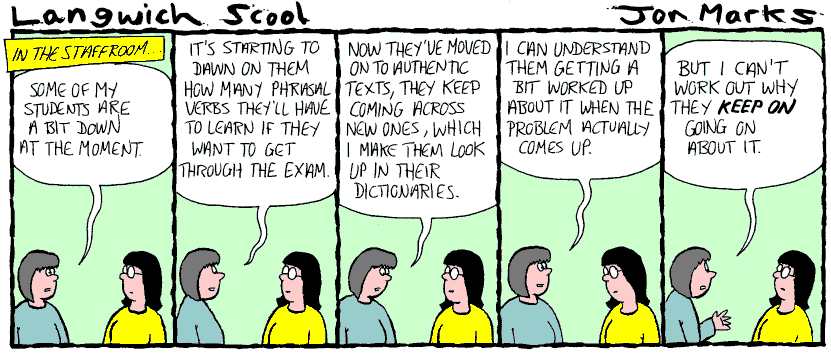
Next week we´re going to learn a bit more about phrasal verbs. As you know, a phrasal verb is a verb and a preposition/particle used together. In English there are hundreds of them. Here you have a list of the most important ones. Read the examples. They´ll be easier to remember if you see them in a sentence.


ESSENTIAL PHRASAL VERBS
                                                              (Intermediate Level)


AGREE WITH - estar de acuerdo - "All women are bad drivers." "I don't agree with you."

BE ABOUT TO - estar a punto de - "I was about to leave the house when my friends arrived."

BE BACK - regresar - "I'm working late at the office tonight so I won't be back until 10."
BE OUT OF - quedarse sin - "We're out of eggs so we can't make a tortilla."
BE OVER - terminarse - "When the football match was over, we went to the pub."
BE UP - estar levantado - "Phil isn't up yet: he's still in bed. Phone again in ten minutes."
BLOW UP - estallar (una bomba) - "The bomb blew up killing six people."
BLOW UP - inflar - "We blew up at least a hundred balloons for the Christmas party."
BREAK DOWN - averiarse - "My car broke down on the way to Motril."


CALL BACK - volver a llamar - "I'm afraid the manager isn't here at the moment. Could you call back later?"
CARRY ON - seguir. continuar - "I'm sorry if I interrupted you. Please carry on."
CARRY OUT - cumplir (una promesa) -"The President carried out his promise to reduce "
CARRY OUT - llevar a cabo - "The execution was carried out at seven o'clock in the morning."
CLEAR UP - poner en orden - "It took four hours to clear up after the party."
COME ACROSS - encontrar, dar con - "I came across an old friend on the metro in Madrid."
COME BACK - regresar - "I'm going to England for two weeks. I'm coming back."

COME IN - entrar - "Good morning. Come in and sit down."
COME ON - ¡Vamos!, ¡Date prisa! - "Come on. We're going to be late."
CUT DOWN ON - consumir menos - "You must cut down on cholesterol or you'll have a heart attack. "
CUT OFF - cortar, desconnectar - "When we didn't pay the bill, the electricity was cut off."
CUT UP - cortar en pedazos - "We cut up the birthday cake and gave everyone a
slice." 


DO UP - abrochar,atar - "I was five before I knew how to do up my shoelaces." 
DO WITH - tener algo que ver con, tener relación con - "What's MS DOS?" "It's got something to do with computers."
DO WITHOUT - pasarse sin, prescindir de - "The shops are shut so we'll have to do without sugar. "
DRAW UP - pararse - "The car drew up at the zebra crossing." 


GET BACK - volver, regresar - "Cinderella had to get back by twelve o'clock. "
GET IN(TO) - entrar - "I lost my keys and so I couldn't get into the house."
GET OFF - bajar (de un autobus, tren) - "You have to get off the bus at the next stop if you want the station."
GET ON
- subir (a un autobus, tren, moto) - "Quick! Get on the train, it's about to leave."
GET UP - levantarse - "When I got up this morning it was still dark."
GIVE BACK - devolver - "If you don't like the dress, the shop will give you your money back."
GIVE UP - perder la esperanza, rendirse - "If you find phrasal verbs difficult, don't give up."
GIVE UPNegrita - dejar (de fumar, beber) - "You'll get cancer if you don't give up smoking."
GO AHEAD - ¡Siga! - "Can I use the telephone?" "Yes, go ahead."
GO AWAY - irse, marcharse - "Are you going away for Christmas, or are you staying at home."
GO BACK - volver, regresar - "Although she's forty, she's going back to University to study French."
GO DOWN - bajar - "The price of fruit goes down in the summer."
GO OUT - salir (por la calle) - "I always go out and have a few drinks on Saturday night."
GO UP - subir - "The price of cigarettes went up in January 1992." 


HANG ON/HOLD ON - esperar - "Hold on for a minute as Pablo will be back in five minute."
HANG UP - colgar (el teléfono) - "My ex-girlfriend hung up when I phoned her." 


KEEP UP WITH - mantenerse (a la altura de) - "I can't keep up with my father when we go cycling as he goes too fast."
KNOCK DOWN - derribar, atropear, demoler - "My grandfather's old house was knocked down and a bank was built." 


LEAVE BEHIND - olvidar, dejar - "When I got to the airport, I realised I had left my passport behind."
LET IN- dejar entrar - "She opened the door and let in the cat."
LOOK AFTER - cuidar - "My mother looks after the children when we go away."
LOOK FOR - buscar - "I spent two hours looking for my glasses before I found them. "
LOOK FORWARD TO - esperar con ilusión - "I'm looking forward to the Easter holidays. "
LOOK OUT - tener cuidado, ¡Ojo!- "Look out! - There's a car coming. "
LOOK UP - buscar algo (en un libro, diccionario) - "If you don't understand the word, look it up in a dictionary." 


PUT IN - meter, introducir - "Put ten pence in the machine and you will get a cup of coffee."
PUT ON - encender - "Put on the light, it's getting dark. "
PUT ON - ponerse (la ropa) - "Put your coat on or you'll get cold. " 


RUN OUT OF - quedars sin algo- " We ran out of petrol so we had to get the bus. " 


SET OFF - ponerse en camino - "We set off to Madrid at five o'clock to avoid the traffic. " 


TAKE AFTER - parecerse a - "Pablo takes after his mother: they are both optimistic. "
TAKE OFF - despegar - "The flight was delayed for two hours and the plane eventually took off at 6 p.m."
TAKE OFF - quitarse la ropa - "Take off your coat and make yourself comfortable."
TAKE OUT - extraer, sacar - "He took out a cigarette and lit it. "
THROW AWAY - tirar (en la basura) - "Don't throw these papers away: they're important."
TURN DOWN - bajar (el volumen) - "Turn down the radio: it's too loud. "
TURN UP - poner el volumen más fuerte - "Turn up the radio. I can't hear it."
TURN ON - encender (televisión, luces etc.) - "Turn on the television, please, I want to see the news."


Some practice?


Phrasal Verbs Matching

Match the phrasal verbs in the first column to the best 

available answer in the second 

column.

_____ blow up               1) choose

_____ throw away         2) omit

_____ look like             3) resemble

_____ leave out            4) postpone

_____ pass away          5) recollect

_____ pick out             6) cancel

_____ work out            7) recover

_____ make up             8) die

_____ pick on               9) find   

                                         
 _____ get over             10) create

_____ put off               11) explode

_____ call off              12) continue

_____ hold on             13) happen

_____ come across     14) wait

_____ look back on    15) discard

_____ carry on           16) admire

_____ take place        17) exercise

_____ look up to       18) bully

 Answer Key:

11 - blow up
15 - throw away
3 - look like
2 - leave out
8 - pass away

1 - pick out
17 - work out

10 - make up
18 - pick on
7 - get over
4- put off
6 - call off

14 - hold on

9 - come across
5 - look back on

12 - carry on

13 - take place

16 - look up to


Some of the TV adverts we watch on TV everyday aren' t dubbed into Spanish. I' m sure the ones I 've posted today are quite familiar to you. How about using them as a resource to improve our English? We can watch them, translate them,  describe them  and give our opinions.
Have a look!


Entradas más recientes Entradas antiguas Inicio

Welcome to my blog!

I have created this blog especially for those who need English and also for those who love it. I hope you find this site useful. If you have any suggestions, ideas, requests or just want to leave a message, please send me an email (cmsanchezh@gmail.com) or fill in this contact form.

Contact form


Popular Posts

  • B1 Speaking Test - Photograph description
    Describing a picture is part of your Cambridge English Preliminary. Don´t panic, take your time and organise your ideas. Here you have ...
  • Saint Patrick' s Day
    Saint Patrick's Day is a yearly holiday celebrated on 17 March. It is a public holiday on the island of Ireland, including N...
  • PASSIVE (3rd / 4th Secondary)
    La voz pasiva se suele utilizar cuando se considera más importante una acción que quien la realiza. Se utiliza además cuando se descon...
  • Saint Valentine´s Day Cards
    Saint Valentine is coming!! =D. Here are some tips and ideas to help you give a perfect Valentine's Day Card to your beloved: B...
  • Passive exercises (all tenses) - (4th Year Secondary)
    WRITE THE VERBS IN THE CORRECT PASSIVE TENSES. 1. My flat    (sell) last week. 2. The room  (not paint) yet. 3. I think the results   ...
  • The story of St Valentine
    Do you know who Saint Valentine was? Why do we celebrate on February 14? Read his "autobiography" and find out why every...
  • Gerund or infinitive? (4th Secondary)
    Learning how to use gerunds and infinitives after a verb can be difficult in English, I know, but don´t panic. Let´s put our ideas in or...
  • Best love songs
    In your opinion, what´s the best LOVE song ever? Waiting for your comments.
  • Quiz
    The National Wallace Monument  on the Abbey Craig, a hill near Stirling, in Scotland, commemorates Sir William Wallace, also known as B...
  • Mapas mentales (Mind maps)
                               Aprender vocabulario en cualquier idioma, sin un contexto, es casi imposible. Todos hemos intentado memoriza...

Labels Cloud

1 ESO 3 ESO 4 ESO About my country adjectives Art Article B1 Biographies Books British History Causative Collocations Common mistakes Comparatives and Superlatives Conditionals Connectors Craft Culture Current affairs Daily Situations Descriptions Educational Information English is fun Environment Exercises False Friends Films Future Tenses Games Geography Gerund and Infinitive Idioms Imperative Interesting Places Interjections Irregular Verbs Job Listening Make vs DO Mathematics Mind maps Miscellany Modal Verbs Paraphrasing Passive Past Continuous Past Perfect Past Simple Past Simple/Present Perfect Personal Information Phonetics Phrasal V erbs Phrasal Verbs Poetry Prepositions Present Continuous Present Perfect Present Simple Projects Pronunciation Quantifiers Question Tags Quiz Quotes and proverbs Reading Recipes Reinforcement Activities Relative Clauses Rephrasing Reported Speech Saxon Genitive Series So/Such Songs Speaking Spelling Sport Subject and Object Questions Tense Revision Time Expressions Used to Vocabulary Writing

Blog Archive

  • ▼  2020 (2)
    • ▼  mayo (2)
      • PASSIVE (3rd / 4th Secondary)
      • Passive exercises (all tenses) - (4th Year Secondary)
  • ►  2019 (5)
    • ►  marzo (1)
    • ►  febrero (4)
  • ►  2018 (18)
    • ►  noviembre (1)
    • ►  octubre (1)
    • ►  julio (1)
    • ►  mayo (5)
    • ►  abril (2)
    • ►  febrero (3)
    • ►  enero (5)
  • ►  2017 (41)
    • ►  diciembre (5)
    • ►  noviembre (2)
    • ►  octubre (4)
    • ►  septiembre (8)
    • ►  junio (2)
    • ►  mayo (1)
    • ►  abril (8)
    • ►  marzo (2)
    • ►  febrero (4)
    • ►  enero (5)
  • ►  2016 (105)
    • ►  diciembre (5)
    • ►  noviembre (7)
    • ►  octubre (7)
    • ►  septiembre (8)
    • ►  agosto (6)
    • ►  julio (10)
    • ►  junio (9)
    • ►  mayo (8)
    • ►  abril (10)
    • ►  marzo (9)
    • ►  febrero (15)
    • ►  enero (11)
  • ►  2015 (135)
    • ►  diciembre (7)
    • ►  noviembre (13)
    • ►  octubre (23)
    • ►  septiembre (8)
    • ►  agosto (6)
    • ►  julio (15)
    • ►  junio (10)
    • ►  mayo (18)
    • ►  abril (13)
    • ►  marzo (8)
    • ►  febrero (6)
    • ►  enero (8)
  • ►  2014 (92)
    • ►  diciembre (7)
    • ►  noviembre (10)
    • ►  octubre (14)
    • ►  septiembre (13)
    • ►  agosto (10)
    • ►  julio (10)
    • ►  junio (8)
    • ►  mayo (11)
    • ►  abril (9)
  • ►  2013 (5)
    • ►  diciembre (1)
    • ►  mayo (1)
    • ►  abril (1)
    • ►  marzo (1)
    • ►  febrero (1)
  • ►  2012 (12)
    • ►  diciembre (1)
    • ►  noviembre (2)
    • ►  octubre (1)
    • ►  septiembre (3)
    • ►  agosto (2)
    • ►  julio (3)
  • ►  2011 (25)
    • ►  noviembre (1)
    • ►  octubre (1)
    • ►  agosto (2)
    • ►  abril (2)
    • ►  marzo (6)
    • ►  febrero (3)
    • ►  enero (10)
  • ►  2010 (113)
    • ►  diciembre (4)
    • ►  noviembre (6)
    • ►  octubre (8)
    • ►  septiembre (8)
    • ►  agosto (6)
    • ►  julio (4)
    • ►  junio (8)
    • ►  mayo (9)
    • ►  abril (9)
    • ►  marzo (15)
    • ►  febrero (17)
    • ►  enero (19)

Followers

Visitors

Geocounter

I am an Edublogger!

I am an Edublogger!
Copyright © 2015 Carmen María's English Blog

Created By ThemeXpose | Distributed By Gooyaabi Templates